Honey Mushrooms (Armillaria) in Michigan
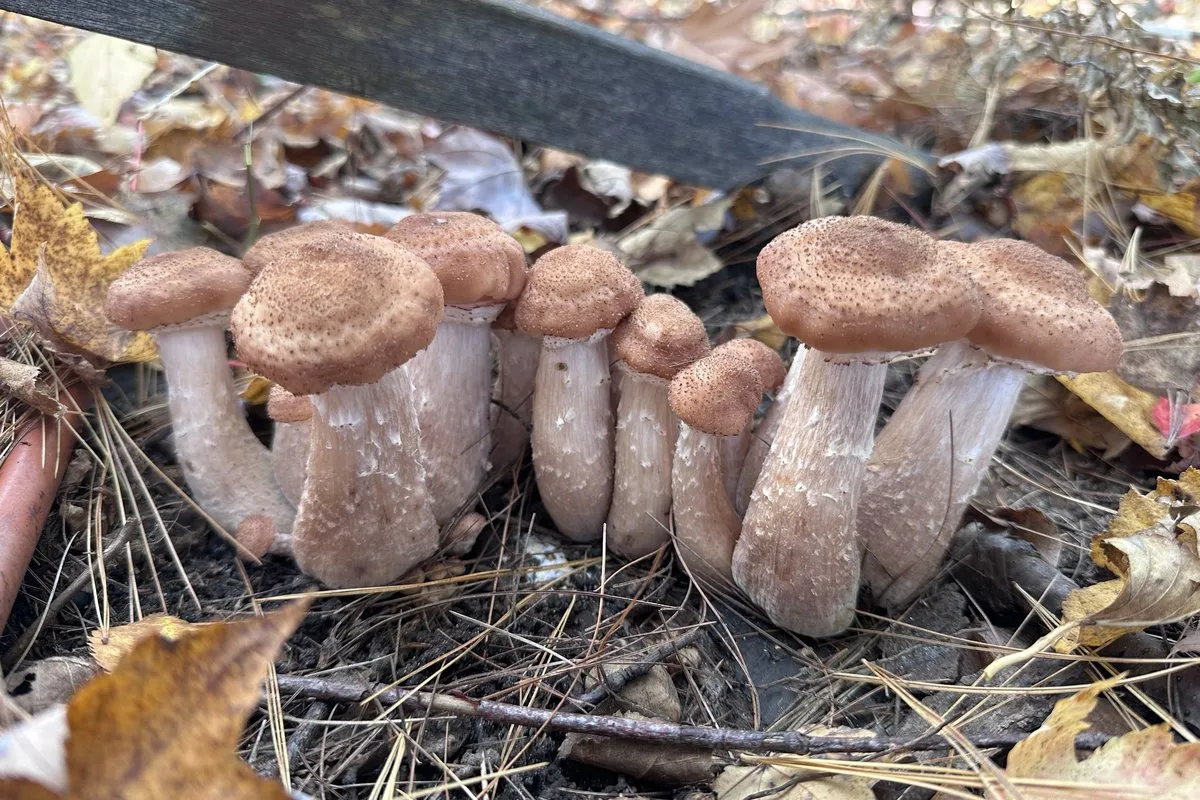
Honey mushrooms are Armillaria species. They grow in late-season clusters on stumps, buried roots and damaged wood across Michigan. Here in Clare County and the oak–maple–pine country of the northern Lower Peninsula, cool wet spells can bring them up. Look for tan to honey-brown caps in cespitose (tightly bunched) groups. The cap often has fine scales. The stem often has a ring or ring zone left by a partial veil. Honey mushrooms are common, but they have a deadly look-alike, so take your time with them.
Honey mushrooms must be cooked thoroughly. Never eat them raw.
Photo note
Hand-held Armillaria cluster from Michigan woods.
Photo: Fungi, Flora & Ferment
What Are Honey Mushrooms?
“Honey mushroom” usually means Armillaria. These are gilled mushrooms that live on wood. They often fruit in dense clusters on hardwood, and sometimes on other woody hosts. Caps are often honey-tan to brownish. Young caps may have darker, hair-like scales toward the center. Many species have a partial veil that leaves a ring or ring zone on the stem. The gills are true gills, attached to the stem. Many of the edible Armillaria taught in North America give a pale or whitish spore print. Confirm this with your regional guides as you learn more.
Armillaria can live on trees and stumps as a parasite or feed on dead wood. So finding them on wood is normal. But that does not mean it’s safe to cook. The species are hard to tell apart. Learn your local kinds with keys and a skilled identifier. Don’t assume every brown cluster on a stump is dinner.
Habitat in Michigan
Look for Armillaria on wood and places tied to wood:
Stumps, standing dead wood and fallen logs in mixed hardwoods
The bases of living or dying trees (where you have permission to look)
Buried roots and wood under leaf litter. Clusters may seem to grow from the ground until you dig carefully.
Cool, wet flushes from late summer through fall. Local rain and temperature set the timing.
Take a photo of the host wood when you can: the bark, nearby leaves and other hardwood clues. Skip spots that may be dirty: sprayed edges, industrial debris and heavy roadside exhaust. Never make up GPS points for private patches. Our foraging ethics guide covers how to share finds.
Identification Checklist
Cap
Rounded, then flatter with age. Colors run from pale honey to tan-brown.
Fine scales or hairs, often thicker toward the center on young caps. Weather can wear them away.
Young caps may show veil bits at the edge.
Gills
True gills (not pores, not spines)
Usually whitish to cream. They may stain with age or handling.
Attached to the stem. Some run slightly down it, depending on the mushroom.
Stem, ring and partial veil
Stems are often fibrous. Bunched bases are common in cespitose growth.
Many Armillaria have a ring or clear ring zone from the partial veil. Note if it’s there, its texture and where it sits.
Check the stem base and where it joins the wood carefully.
How it grows
Often cespitose: many caps from one shared or tightly bunched base on wood
Fairly firm flesh when young. Older ones get tougher and fill with insect tunnels.
Spore print (a helper, not proof)
Edible Armillaria often give pale or whitish prints. Use regional guides. Never treat print color alone as a green light.
Positive ID means you’re sure of the genus, and of the species when your skill allows. You know the host wood. The ring and scales fit. And you’ve ruled out the deadly look-alikes. Only then do you plan a meal.
Look-Alike Warnings (Read Carefully)
Many brown gilled mushrooms grow on wood. So this section leans hard on caution.
Deadly Galerina group (especially the Galerina marginata complex)
Small to medium brown mushrooms on wood, often with a ring, include species with deadly amatoxins. To a careless beginner, they look like the same “brown on wood with a ring” mushroom. Size, gill color changes and growth pattern all matter. So does the spore print, which is often rusty brown in Galerina. Study them with a mentor. A wrong brown wood mushroom can kill. If you can’t rule out Galerina and other toxic look-alikes with trained confidence, do not pick it for food.
Other brown gilled mushrooms on wood
Many kinds of mushrooms grow brown caps on stumps, in clusters or scattered. Color alone tells you nothing. Use keys to check the veil, flesh, smell and growth pattern. Add spore prints as you learn more. Don’t go on a gut feeling.
Pale wood mushrooms and mixed clusters
Never assume every mushroom in a stump cluster is the same species. Sort them carefully. Photograph each one. Leave any you’re unsure of.
Many mentors treat honey mushrooms (Armillaria) as a step-up ID, not a first one, because the look-alikes are serious. A guess on social media is not an ID.
Always Cook Them Thoroughly
Even when you’re sure it’s a honey mushroom:
Cook thoroughly. Do not eat honey mushrooms raw.
Start with small portions after a solid ID. People react differently.
Skip old, waterlogged or insect-tunneled clusters.
Raw or undercooked honey mushrooms often come up in foragers’ upset-stomach stories. Cook them well after you ID them. Cooking does not replace the ID.
Harvest and Kitchen Quality
Get permission on private land.
Take young, clean clusters you’ll cook soon.
Cut cleanly from the wood. Leave the mycelium and plenty of mushrooms behind.
Check for bitterness from age, too much water and insect tunnels.
Store them cool and cook them soon, only after a positive ID. Or dry them fully, if you know how to dry confirmed mushrooms.
Cooking Notes (After Positive ID)
For confirmed honey mushrooms (Armillaria), cooked thoroughly:
Separate the caps. Many cooks keep the caps and skip the tough stem bases. Ask local mentors what they keep.
Dry-sauté or simmer long enough to cook them all the way through.
A classic in stews and skillets with onion and garlic, after a solid ID.
Label dried mushrooms Armillaria / honey mushroom, with the date and host wood.
Cook them thoroughly, every time.
Weather, Timing and Field Notes
Honey mushrooms often come up after cool rains in late summer and fall. Write down whether they grew from a stump or a buried root. Note the cap scales, the ring, the cluster’s age and the type of wood. Go back to the same stump, with permission, over a season. You’ll learn more than from one trophy photo, and you’ll practice walking away when unsure.
Common Mistakes
“A brown cluster on a stump means honey mushrooms”
Ignoring Galerina and other deadly look-alikes on wood
Eating raw or barely wilted Armillaria after ID
Putting different species from one stump into one bag
Skipping photos of the underside, stem ring and wood for your mentor
Slow down. Caution is part of the craft.
Keep Learning
Honey mushrooms (Armillaria) take some care. Know the host wood. Note how they cluster. Check the ring and scales. Cook them thoroughly after a positive ID. And respect deadly look-alikes such as Galerina. More guides are on Learn.
Key takeaway: Tight clusters on wood. Check the scales and veil. Rule out Galerina and other toxic look-alikes. Eat only a positive Armillaria ID, and cook it thoroughly.
