
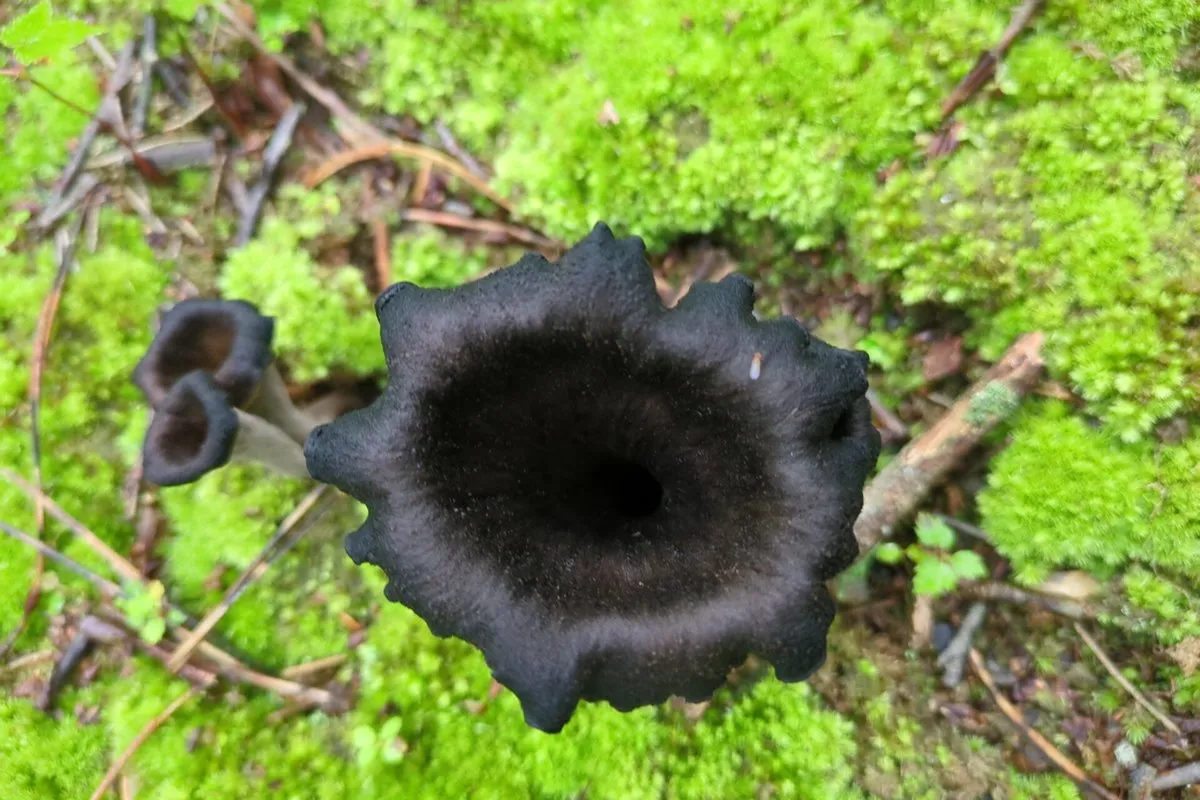
Black Trumpets (Craterellus) in Michigan
Black trumpets are Craterellus species, often talked about with names like horn of plenty. They’re dark, vase-shaped mushrooms that hide in plain sight on the forest floor. They grow in Clare County and the oak–maple–pine country of the northern Lower Peninsula. Their charcoal-to-brown funnels blend into the leaf litter until your eyes adjust. Once you learn the hollow trumpet shape, they become a highlight of summer and fall walks. Always get a careful, positive ID first.
Before you cook any, be sure you have the real thing: a hollow, dark funnel with no sharp gills. If you’re not sure, leave it.
What Are Black Trumpets?
Among foragers, “black trumpet” usually means a dark Craterellus mushroom. It has a hollow tube or funnel shape. The outside is smooth to slightly wrinkled, without sharp true gills. Some close relatives look similar, and an experienced forager can help you sort them out. Color runs from brown-black to gray-black. Prime ones are often fluted, with thin flesh.
They grow from the ground in forests and partner with tree roots. They are not shelves on logs like Laetiporus or Trametes.
Habitat in Michigan
Black trumpets often show up in:
Mossy hardwood floors and mixed oak–pine litter
Damp dips and trail edges after rain
Scattered groups. They’re easy to walk past until you spot one, and then suddenly you see dozens.
They usually show up from summer into fall when there’s enough rain. Local weather sets the timing. Habitat clues help you scout. They don’t replace an ID. Keep private spots private. Our foraging ethics guide explains why.
Identification Checklist
Overall shape
A hollow trumpet, vase or tube that opens upward
Thin flesh compared with chunky gilled mushrooms
Often dark gray, brown or blackish
Outer surface
Smooth to wrinkled or lightly veined. Not the sharp, plate-like gills of many mushrooms.
May feel a little waxy or soft when fresh
Inside
In typical black trumpets, the hollow center runs on into the funnel.
Check for debris packed inside.
How it grows
From soil or leaf litter in the woods, often in groups
Easy to miss against dark leaves
Positive ID means you know Craterellus black trumpets, as far as you can name them in your region. You can also rule out the look-alikes before you cook.
Look-Alikes and Caution
Dark forest mushrooms deserve respect:
Other dark funnel or cup fungi can look similar in leaf litter. Study the size, texture and season. Look closely at the underside and outer surface.
Rotting matter and blackened leaves can look like “trumpets” to tired eyes. Touch and shape matter.
Beginners should learn beside someone experienced before filling a basket.
When in doubt, leave it. Take photos where it grows. Show the leaf litter around it and a clear view of the hollow funnel.
Why They’re Easy to Miss (and Worth Slowing Down For)
In late summer, leaf litter can look all brown from standing height. Kneel down and tilt your head, and you’ll start to catch the round openings of black trumpets. Search small patches slowly instead of speed-walking and scanning for color. That habit also means less trampling and less overpicking.
Harvest Notes
Get permission on private land.
Pinch or cut cleanly. Don’t rake up and ruin the moss.
Take only what you’ll clean and cook or dry soon. Trumpets can hide grit.
Leave some scattered behind so the spot keeps producing.
Cooking Notes (After Positive ID)
Confirmed black trumpets (Craterellus) are prized when cooked thoroughly:
Split them and gently shake or rinse out the grit. Dry the surface before the pan.
Dry-sauté, then finish with butter, shallot, cream, eggs or pasta.
Excellent dried, since the aroma gets stronger. Label them Craterellus / black trumpet, with the date.
Always cook thoroughly. Some people are sensitive. Try a little at first, after a solid ID.
Drying Basics
Positive ID only. Clean out the grit patiently.
Dry until crisp. They dry thin and light.
Store airtight, cool and dark.
Soak briefly, or crumble them into simmering sauces.
Field Tips Just for Trumpets
Black trumpets reward patience more than speed. A slow ten minutes in one mossy pocket often beats a rushed mile of trail.
Get low and change your angle. Dark funnels pop out when light hits the openings.
Once you find one, search the litter around it in a slow spiral.
Go for quality, not volume. Muddy, collapsing trumpets dry poorly.
Black Trumpets and Other Mushrooms
Black trumpet season often comes up alongside chanterelle (Cantharellus) weeks and late chicken of the woods (Laetiporus). That’s true even when they fruit at different times. Use walks where they overlap to practice switching ID checklists. Funnels from the soil, false gills and shelves on wood each need a different check. Switching between them well is what keeps beginners safe.
Cleaning trumpets is half the work. Split them lengthwise and tap out the litter. Getting a basket perfectly grit-free takes patience. Once they’re clean, thin trumpets dry easily. Just don’t dry mud.
Keep Learning with Fungi, Flora & Ferment
Black trumpets (Craterellus) reward patient eyes in Michigan leaf litter. Look for hollow dark funnels, clean them carefully and cook them thoroughly. For more guides on morels, chanterelles, oysters, turkey tail, chicken of the woods and foraging ethics, see Learn.
Key takeaway: Hollow dark trumpets in the litter. Get a positive Craterellus ID, be patient with the grit and use a hot pan. Never guess from a blurry photo.
Cover photo: Court Harding / Wikimedia Commons (CC BY 4.0), cropped
